Stroke Symptoms: FAST Signs, First 3 Hours, When to Rush to Hospital
Face drooping, arm weakness or slurred speech means stroke until proven otherwise. The first 3 hours decide recovery. Know FAST signs, 24x7 emergency in Bhopal.
Someone suddenly cannot speak clearly. One side of the face looks weak. An arm drops when they try to lift both hands. The dangerous mistake is waiting to see if it "settles."
Fast rule: if stroke symptoms start suddenly, do not wait for an appointment. Go to emergency care now or call local emergency services. Stroke symptoms are time-sensitive because early medical assessment can reduce the chance of severe brain injury.
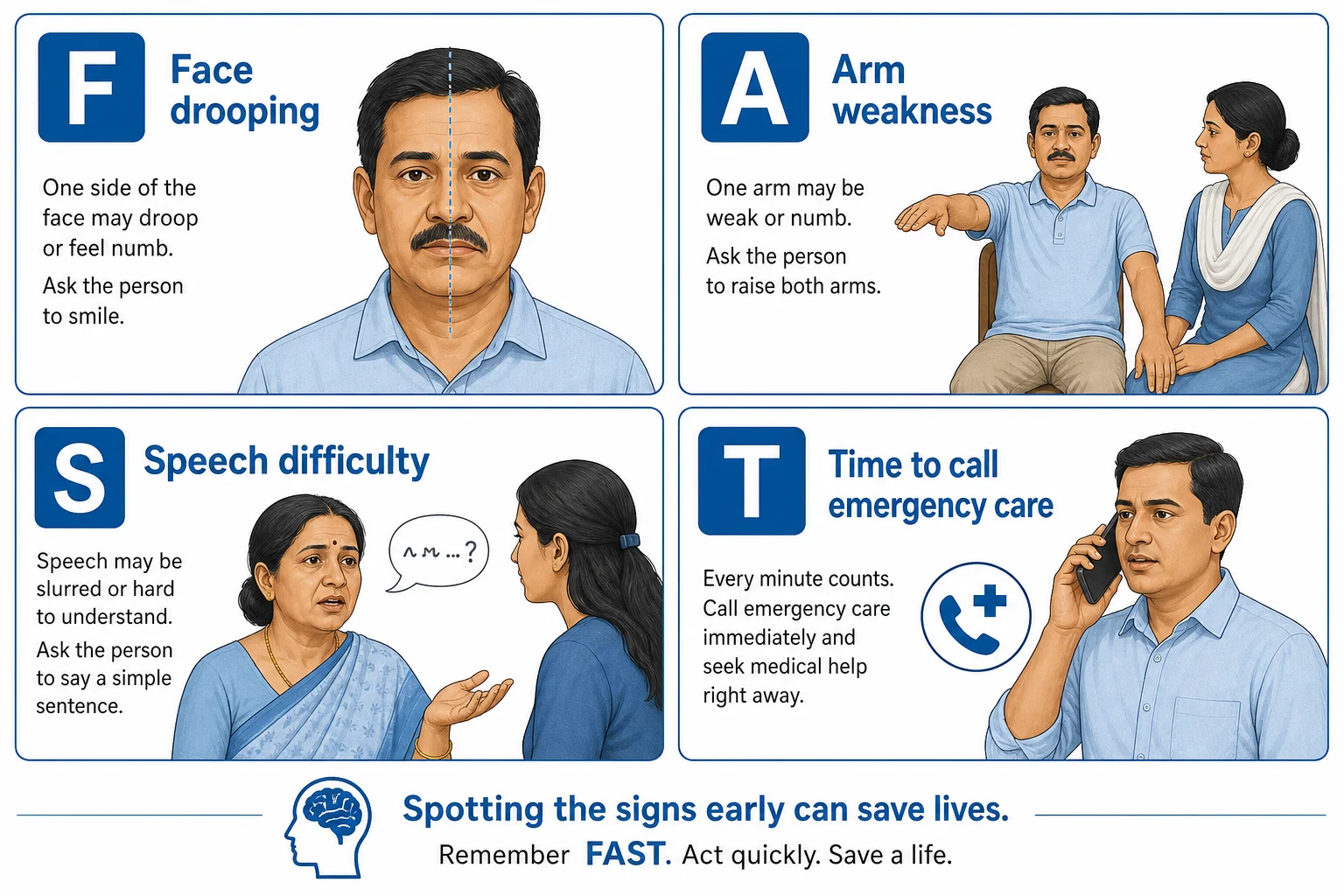
People reading about stroke symptoms usually need a quick decision rule, not a long medical lecture. The safest rule is to treat sudden face drooping, arm weakness, speech trouble, balance trouble, vision change, severe unusual headache, or confusion as urgent and seek emergency care immediately.
What are stroke symptoms?
Stroke symptoms are sudden neurological changes such as face drooping, arm weakness, speech difficulty, confusion, vision trouble, severe unusual headache, dizziness, or loss of balance. They can be mild at first, but sudden onset is the key warning sign. Do not use this article to diagnose the cause at home.
The CDC explains that fast treatment can lessen brain damage from stroke, and Mayo Clinic advises emergency medical care if stroke symptoms appear, even if they go away. Sources: CDC stroke signs and symptoms and Mayo Clinic stroke symptoms.
What does FAST mean for stroke warning signs?
FAST is a simple emergency check: Face, Arm, Speech, Time. If the face droops, one arm is weak, or speech is slurred or confused, the "T" means time to seek emergency care immediately. You do not need all three symptoms for it to be urgent.
Use this quick check:
| FAST check | What to ask or observe | Why it matters |
|---|---|---|
| Face | Ask the person to smile. Is one side drooping? | One-sided facial weakness can be a stroke sign |
| Arm | Ask them to raise both arms. Does one drift down? | One-sided weakness is a common warning sign |
| Speech | Ask them to repeat a simple sentence. Is speech slurred, strange, or absent? | Speech difficulty can signal brain involvement |
| Time | Note when symptoms started and get emergency help | Doctors need symptom timing for urgent decisions |
The NHS and American Stroke Association use FAST for public stroke awareness because it is easy for families to remember in a stressful moment. Sources: NHS Act FAST and American Stroke Association FAST.
What is BE-FAST, and when is FAST not enough?
BE-FAST adds Balance and Eyes to the FAST check. This matters because some strokes may start with sudden dizziness, trouble walking, loss of coordination, double vision, or vision loss, even before obvious face or arm weakness appears.
BE-FAST can be remembered like this:
- B - Balance: sudden trouble walking, severe dizziness, loss of coordination
- E - Eyes: sudden blurred vision, double vision, or loss of vision in one or both eyes
- F - Face: one side of the face droops or feels weak
- A - Arm: one arm or leg is weak, numb, or drifting down
- S - Speech: slurred speech, wrong words, confusion, or inability to speak
- T - Time: get emergency care and note the time symptoms began
Do not argue with the symptom. If a person was normal a few minutes ago and now cannot speak, walk, see normally, or move one side properly, treat it as an emergency until a doctor says otherwise.
Can stroke symptoms come and go?
Yes, stroke-like symptoms can sometimes improve or disappear, but temporary improvement is not a safe reason to stay home. A short episode may still need urgent medical evaluation because the same warning signs can precede a larger event or reveal a serious underlying problem.
Families often delay because the patient says, "I am fine now." That delay is risky. If symptoms were sudden and neurological, especially weakness, speech change, vision change, confusion, or severe headache, the safer action is urgent assessment.
What should you do immediately if stroke is suspected?
The easiest path is: stop guessing, note the time, keep the person safe, and reach emergency care. Do not give food, water, aspirin, blood pressure tablets, sleeping pills, or home remedies unless a doctor or emergency team specifically advises it.
Checklist:
- note the exact time the person was last seen normal
- call local emergency services or take the person to the nearest emergency department
- keep the person sitting or lying safely
- do not let them drive themselves
- bring current medicine names, blood thinner details, diabetes or BP history, and old reports if available
- tell the emergency team clearly: "possible stroke symptoms started at this time"
Mayo Clinic's first aid guidance also emphasizes calling emergency help right away for stroke symptoms. Source: Mayo Clinic stroke first aid.
Which symptoms are stroke red flags?
Any sudden face, arm, speech, vision, balance, or severe headache symptom should be treated seriously. Stroke is not always painful. A person may be awake and still have a major neurological emergency.
Seek emergency care immediately for:
- sudden weakness or numbness of face, arm, or leg, especially on one side
- sudden slurred speech, inability to speak, or trouble understanding speech
- sudden confusion or unusual behavior
- sudden vision loss, double vision, or severe blurred vision
- sudden severe headache, especially if unusual for that person
- sudden dizziness, loss of balance, or inability to walk normally
- seizure, fainting, or reduced consciousness with any of the above symptoms
What should you not do during possible stroke?
Do not try to treat suspected stroke at home. The wrong medicine can be harmful, and valuable time can be lost while families wait for symptoms to settle.
Avoid these common mistakes:
| Mistake | Why it is unsafe |
|---|---|
| Waiting for symptoms to improve | Time-sensitive treatment decisions may be missed |
| Giving aspirin without advice | Some strokes involve bleeding, where this may be dangerous |
| Giving food or water | Swallowing may be unsafe if speech or alertness is affected |
| Letting the patient sleep it off | Worsening may be missed |
| Driving far past nearby emergency care | Stabilization and assessment should not be delayed |
This is patient-education guidance, not a diagnosis. The emergency doctor will decide which tests and treatment path are appropriate after examination.
How is stroke checked in the emergency room?
In the emergency room, doctors quickly check symptoms, timing, vitals, blood sugar, neurological signs, medicines, and risk factors. Depending on the case, they may advise blood tests, ECG, CT/MRI imaging, specialist referral, admission, or transfer to a higher stroke-capable center.
Bring this information if possible:
- time symptoms started or last-known-normal time
- BP, diabetes, heart disease, previous stroke, or seizure history
- current medicines, especially blood thinners
- allergy history
- recent surgery, bleeding, head injury, fever, or infection
- old prescriptions, discharge summaries, and test reports
If BP is very high along with sudden neurological symptoms, do not try to lower it quickly at home; read the focused guide on high BP symptoms and emergency signs and reach emergency care. If you want to understand how emergency triage works, read what happens in a hospital emergency room. For symptoms that overlap with anxiety or chest discomfort, do not self-label the cause; see our note on anxiety symptoms and chest pain confusion.
If one-sided weakness, slurred speech, confusion, or drowsiness started after a fall or blow to the head, also check the head injury warning signs guide while arranging urgent medical care.
When should Bhopal families go to hospital?
In Bhopal, go to the nearest emergency department immediately for sudden stroke warning signs. If symptoms are severe, the person is drowsy, cannot walk, cannot speak, has seizures, or has breathing difficulty, call emergency transport instead of using a private two-wheeler or letting the patient walk.
R.K. Hospital, Indrapuri, Bhopal provides 24/7 emergency assessment, vitals monitoring, blood tests, ECG, and urgent medical review. If advanced stroke imaging or specialist intervention is needed, the emergency team can guide the next step after stabilizing the patient.
For urgent help, call 0755-4260605 or come to the emergency department. For non-emergency appointments, use the contact page.
FAQ
What are the FAST symptoms of stroke?
FAST means Face drooping, Arm weakness, Speech difficulty, and Time to call emergency care. If any one of these appears suddenly, treat it as urgent and get medical help immediately.
Can stroke symptoms come and go?
Yes. Stroke-like symptoms can sometimes improve or disappear, but that does not make them safe to ignore. Sudden weakness, speech trouble, face drooping, vision change, severe headache, or balance trouble should be assessed urgently.
Should I give aspirin at home if I suspect stroke?
Do not give aspirin or any medicine at home unless a doctor or emergency team advises it. Some strokes are caused by bleeding, and medicines can be unsafe without medical assessment.
Which stroke symptoms need immediate hospital care?
Sudden face drooping, one-sided arm or leg weakness, slurred speech, confusion, vision loss, severe unusual headache, dizziness, or loss of balance need immediate emergency care.
Bottom line
Gradual or recurring isolated hand tingling still deserves review; see the fingertip numbness guide. Sudden one-sided numbness with face, speech, vision, or balance change remains an emergency.
Stroke symptoms are an emergency because the useful window for assessment can be short. Use FAST or BE-FAST, note the symptom start time, avoid home medication, and reach emergency care quickly. If you are unsure whether it is stroke, that uncertainty is exactly why a doctor should assess the patient urgently.
R.K. Hospital, Indrapuri, Bhopal has 24/7 emergency support for sudden weakness, speech change, altered consciousness, severe headache, and other urgent symptoms. Call 0755-4260605 or visit the emergency department.
Where this guide fits in urgent care
Use this information to recognise when prompt assessment is needed. Severe or rapidly worsening symptoms should be assessed through the nearest appropriate emergency service.
Emergency care, warning signs and contact informationRelated Pages on R.K. Hospital
Read Next
- Allergic Reaction Symptoms: When Is It Anaphylaxis and an Emergency?Emergency Care · 9 min read
- Chest Pain and Breathlessness: When Is It a Heart Emergency?Emergency · 10 min read
- Head Injury Symptoms: Warning Signs of Brain Bleed After a Fall or HitEmergency · 11 min read
- Appendicitis Symptoms: When Is It an Emergency?Surgery · 5 min read
- Gallbladder Stone Emergency Signs: When Pain Should Not Be IgnoredSurgery · 3 min read
Need a Doctor in Bhopal? Talk to R.K. Hospital
This article is for general information only and does not replace a consultation. Call, WhatsApp, or walk in 24x7 at R.K. Hospital, Indrapuri, near Bima Hospital.
226, C-Sector, Indrapuri, Raisen Road, Bhopal (M.P.) 462022 · Directions & timings · 24x7 Emergency