Blood Infection Symptoms: Sepsis Warning Signs
Blood infection turns into sepsis when fever comes with confusion, fast breathing, low urine or severe weakness. Know the signs. 24x7 emergency in Bhopal.
Fever ya infection mein family ka most dangerous confusion yeh hota hai: "Ghar par wait karein ya emergency jaayein?" Search mein log ise blood infection symptoms, sepsis symptoms, ya infection body mein failne ke lakshan bolkar dhoondte hain. Practical answer simple hai: infection ke saath patient rapidly worse lag raha hai toh online diagnosis ka wait mat karein.
Fast rule: fever or suspected infection with confusion, severe weakness, breathlessness, very low urine, fainting, blue lips, cold/clammy skin, severe drowsiness, or rapid worsening needs emergency care. Blood infection ko ghar par confirm ya rule out karne ki koshish time waste kar sakti hai.
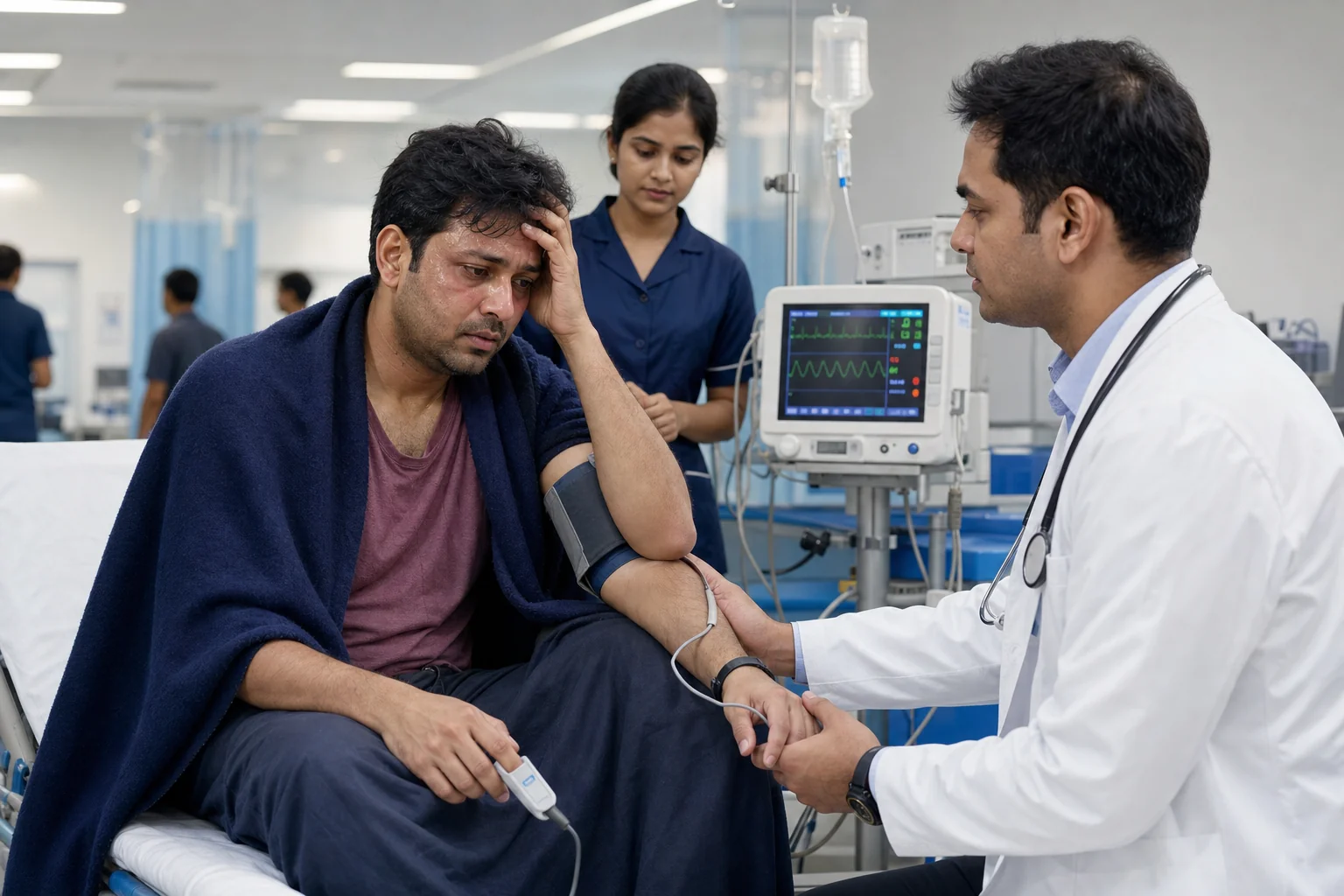
This guide is patient education, not diagnosis or prescription advice. Is page ke basis par antibiotic, steroid, painkiller, injection, or IV fluid khud se start na karein. If the patient is severely unwell, confused, breathless, fainting, not passing urine, blue around lips, unusually drowsy, or rapidly worsening, seek emergency care immediately. R.K. Hospital, Indrapuri, Bhopal has 24/7 emergency support; call 0755-4260605 for urgent guidance.
What are blood infection symptoms?
Blood infection symptoms usually means warning signs of a severe infection or possible sepsis: fever or low temperature with confusion, severe weakness, fast breathing, breathlessness, very low urine, fainting, blue lips, cold/clammy skin, severe drowsiness, or rapid worsening. These signs need urgent medical assessment, not home diagnosis.
The phrase "blood infection" is not enough to decide the cause. A patient may have pneumonia, urine infection, abdominal infection, dengue complication, wound infection, post-surgery infection, or another source. Doctors focus first on whether the infection is affecting breathing, blood pressure, alertness, urine output, or organ function.
Seek emergency care now if infection symptoms come with:
- confusion, unusual behavior, severe drowsiness, or hard-to-wake state
- breathlessness, fast breathing, blue lips, or inability to speak full sentences
- fainting, severe dizziness, collapse, or very cold/clammy skin
- very low urine output or no urine for many hours
- severe weakness where the patient cannot sit, walk, drink, or respond normally
- fever with stiff neck, seizure, severe headache, or severe abdominal pain
- persistent vomiting, dehydration signs, or rapidly worsening condition
- recent surgery, wound redness/pus, pregnancy, diabetes, kidney disease, elderly age, baby/young child, or weak immunity with worsening fever
The CDC explains sepsis as the body's extreme response to an infection and a life-threatening medical emergency. The NHS sepsis guidance also lists serious warning signs such as confusion, fast breathing, breathlessness, mottled or blue skin, rash that does not fade, and extreme illness. Families should not try to diagnose sepsis at home, but these warning signs should trigger urgent care.
What is sepsis?
Sepsis is a life-threatening medical emergency that can happen when the body's response to an infection starts harming its own tissues and organs. It can develop from infections in the lungs, urinary tract, abdomen, skin, wounds, or other sites. It needs urgent clinical assessment and treatment decisions by a medical team.
Sepsis is not the same thing as every fever. Most fevers are not sepsis. The risk rises when the patient looks seriously ill, becomes confused, breathes fast, passes very little urine, faints, has very low blood pressure symptoms, or worsens quickly.
The Mayo Clinic sepsis overview describes sepsis as a serious condition that needs immediate medical care and can progress to septic shock. This is why the safer family decision is based on warning signs, not on waiting for one specific report.
How do you decide between OPD and emergency for infection?
Use emergency care when infection symptoms are severe, changing fast, or affecting breathing, alertness, urine output, circulation, or hydration. Routine OPD may be reasonable for stable fever or mild infection symptoms, but it should not delay urgent care when red flags appear.
| Situation | Safer action |
|---|---|
| Mild fever, patient alert, drinking fluids, passing urine, no breathlessness | Doctor consultation or OPD review depending on duration and history |
| Fever for more than 2-3 days, weakness, cough, urine burning, loose motions, or body ache but stable | Same-day doctor review and tests if advised |
| Fever with confusion, fainting, severe drowsiness, or unusual behavior | Emergency care now |
| Infection symptoms with breathlessness, blue lips, fast breathing, or chest pain | Emergency care now |
| Very low urine, repeated vomiting, severe dehydration, cold/clammy skin, or collapse | Emergency care now |
| Recent surgery/wound infection with high fever, pus, severe pain, or rapid worsening | Emergency care now |
| Baby, elderly patient, pregnant patient, diabetic patient, kidney/heart disease, cancer therapy, or weak immunity with worsening symptoms | Lower threshold for urgent hospital assessment |
If fever is the main concern but the patient is stable, this hospital fever warning signs guide can help you decide how quickly to come in. If breathlessness is prominent, use the focused guide on difficulty breathing and when to go to hospital.
If the suspected infection seems chest-related, with khansi, balgam, fever, chest discomfort, wheezing, or saans phoolna, this lungs infection symptoms in Hindi guide gives a clearer OPD-versus-emergency checklist for families.
Can blood tests confirm blood infection?
Blood tests can support the diagnosis, but no single report should be treated as the whole answer. Doctors may use CBC, CRP, ESR, blood culture, urine test, kidney/liver function, blood sugar, lactate in selected settings, X-ray, ultrasound, or other tests based on symptoms and examination.
Common tests doctors may consider:
- CBC to look at WBC pattern, hemoglobin, and platelets
- CRP or ESR as inflammation markers
- blood culture in selected cases where bloodstream infection is suspected
- urine routine/culture when urinary infection is possible
- dengue, malaria, typhoid, or other fever tests when relevant
- kidney, liver, electrolyte, and sugar tests when the patient looks unwell
- chest X-ray, ultrasound, or other imaging when symptoms point to a source
Blood culture is a lab test that may help identify germs in the blood in selected cases, but treatment decisions depend on the full clinical picture. The MedlinePlus blood culture test guide explains that blood cultures are used to find infection in the blood, while symptoms and other tests still matter.
For inflammation-marker reports, read CRP test meaning in Hindi and ESR test meaning in Hindi. If urine symptoms are present, this UTI symptoms in women guide explains why fever plus urinary symptoms needs proper review.
What should you do before reaching hospital?
The easiest safe path is to keep the patient stable, avoid self-medication, note the timeline, and reach emergency care quickly when red flags are present. Do not spend time searching for the perfect term if the patient is getting worse.
Use this quick checklist:
- note when fever, chills, weakness, vomiting, urine symptoms, cough, wound pain, or confusion started
- write the highest temperature, pulse/oxygen/BP readings if checked correctly
- bring current medicine names, allergies, old prescriptions, discharge summaries, and recent reports
- tell the team about diabetes, BP, kidney disease, pregnancy, recent surgery, cancer therapy, steroid use, or weak immunity
- avoid starting leftover antibiotics, steroids, painkillers, or injections without a doctor's advice
- do not let a fainting, breathless, confused, or severely weak patient drive or travel alone
- arrange emergency transport if the patient is unstable
If there is severe abdominal pain with infection symptoms, read severe abdominal pain: when to go to hospital. If the patient is vomiting, passing very little urine, or looks dehydrated, this dehydration symptoms guide can help families explain the warning signs while arranging care.
What will doctors check in the emergency room?
In emergency care, the first job is to check whether infection is affecting breathing, circulation, alertness, hydration, blood sugar, urine output, or organ function. Testing and treatment priorities depend on severity, age, risk factors, and suspected infection source.
The emergency team may check:
- temperature, pulse, blood pressure, respiratory rate, oxygen saturation, and blood sugar
- alertness, dehydration, breathing effort, skin temperature, and urine output
- chest, abdomen, urine, wound, throat, skin, or neurological symptoms
- CBC, CRP, kidney/liver function, electrolytes, cultures, urine test, or fever tests when advised
- X-ray, ultrasound, ECG, or referral depending on symptoms
- observation, admission, transfer, or OPD follow-up depending on stability and findings
For the step-by-step hospital flow, read what happens in a hospital emergency room. Emergency rooms treat patients by severity, so a confused or breathless patient may be seen faster than a stable fever patient who arrived earlier.
When should Bhopal families come to R.K. Hospital?
Come to emergency care immediately when fever or suspected infection is paired with confusion, breathlessness, severe weakness, very low urine, fainting, blue lips, cold/clammy skin, severe drowsiness, wound infection after surgery, or rapid worsening. Stable fever can be reviewed in OPD, but red flags should not wait.
R.K. Hospital, Indrapuri, Bhopal provides 24/7 emergency assessment, vitals monitoring, pathology support, imaging support, physician review, and referral guidance when severe infection is suspected. The practical goal is not to self-label the illness as "blood infection"; it is to quickly assess whether the patient needs urgent treatment, observation, admission, or safe follow-up.
For urgent help, call 0755-4260605 or visit the emergency department. For non-emergency appointments, use the contact page or review available hospital services.
FAQ
Blood infection symptoms kya hote hain?
Blood infection bolkar log usually severe infection ya sepsis warning signs search karte hain. Fever ya low temperature ke saath confusion, severe weakness, fast breathing, breathlessness, very low urine, fainting, blue lips, severe drowsiness, or rapid worsening ho toh emergency care lein.
Sepsis symptoms mein emergency kab jaana chahiye?
Possible sepsis symptoms emergency hote hain agar infection ke saath confusion, breathlessness, very low urine, severe weakness, fainting, blue lips, cold/clammy skin, very fast worsening, or very unwell appearance ho. Home observation ya routine OPD ka wait na karein.
Kya blood infection blood test se confirm hota hai?
Blood culture selected cases mein germ identify karne mein help kar sakta hai, but sepsis ya severe infection ka decision sirf ek test se nahi hota. Doctor symptoms, vitals, examination, CBC, CRP, cultures, imaging, urine test, and organ-function reports together dekhte hain.
Severe infection mein hospital jaane se pehle kya karein?
Patient ko safe position mein rakhein, fever/symptom start time note karein, medicines and reports carry karein, and emergency transport arrange karein. Antibiotic, steroid, painkiller, or extra medicines khud se start na karein unless doctor has advised that exact plan.
Bottom line
Blood infection symptoms ka safest practical meaning yeh hai: infection ke saath patient seriously unwell ya rapidly worse lag raha hai toh emergency care lein. Fever number, CRP value, or online symptom list se ghar par sepsis rule out nahi hota.
R.K. Hospital, Indrapuri, Bhopal mein fever evaluation, pathology testing, physician consultation, and 24/7 emergency support available hai. Call 0755-4260605 for urgent guidance or come to the emergency department when warning signs are present.
Part of the fever, dengue and when to seek urgent assessment guide
From this question to a practical consultation
Use this guide to prepare the history for a discussion about fever, dengue and when to seek urgent assessment. Record when the concern began, what has changed and how it affects daily activities. Bring reports and prescriptions already available; you can ask which further tests would help before arranging more investigations.
At the visit, ask what the clinician thinks is most likely and which findings support that view. If the diagnosis remains uncertain, ask how it will be clarified and which changes should prompt earlier assessment. A clear next step is more useful than collecting several possible labels from online searches.
Before leaving, confirm the purpose of each prescribed treatment, the follow-up date and who will communicate results. Keep that plan with your symptom record so a review can compare progress. Tell the clinician if the plan is difficult to follow because of work, costs, side effects or care responsibilities.
- 1
Record day of illness and symptoms
- 2
Assess hydration and warning signs
- 3
Order time-appropriate tests if needed
- 4
Review recovery or escalate promptly
The sequence explains planned care. Urgent symptoms require prompt assessment and may change this pathway.
The assessment before a treatment decision
Testing is chosen according to the suspected cause and timing. A negative or positive test needs interpretation in the context of symptoms and the day of illness. Ask whether repeat assessment is needed if the illness changes.
Medical guidance: WHO: Dengue and severe dengue
How can I prepare for an assessment of these symptoms?
Bring a symptom timeline, relevant reports, current prescriptions and your main questions. Ask how the diagnosis will be assessed, whether further tests are needed, what follow-up is planned and which changes require earlier care.
Continue with symptoms, treatment options, warning signs and related guides
Related Pages on R.K. Hospital
Read Next
- Dengue Ke Khatarnak Warning Signs: Patient Ko Hospital Kab Le JayeinGeneral Health · 2 min read
- Dengue Warning Signs: Symptoms That Mean the Patient Needs AdmissionGeneral Health · 2 min read
- Lungs Infection Symptoms in Hindi: Khansi-Bukhar Kab Pneumonia HaiEmergency · 11 min read
- Behoshi Ke Baad Hospital Kab Jayein: Fainting Warning Signs in HindiEmergency Care · 11 min read
- Head Injury Symptoms: Warning Signs of Brain Bleed After a Fall or HitEmergency · 11 min read
Need a Doctor in Bhopal? Talk to R.K. Hospital
This article is for general information only and does not replace a consultation. Call, WhatsApp, or walk in 24x7 at R.K. Hospital, Indrapuri, near Bima Hospital.
226, C-Sector, Indrapuri, Raisen Road, Bhopal (M.P.) 462022 · Directions & timings · 24x7 Emergency