MCHC Blood Test Meaning in Hindi: Low, High, Normal Range
MCHC blood test ka matlab kya hota hai? Learn how to read low MCHC, high MCHC, MCV, MCH, RDW, and hemoglobin together in a CBC report, with clear doctor guidance.
Your CBC report says MCHC low or MCHC high, and the red mark on the report makes it look serious. The useful question is not "Is this one number dangerous?" The useful question is: what does MCHC mean when read with hemoglobin, MCV, MCH, RDW, and your symptoms?
Fast rule: if your hemoglobin is normal, you feel well, and only MCHC is mildly outside range, it is usually a discussion point for your doctor, not a panic trigger. If low MCHC comes with very low hemoglobin, breathlessness, chest pain, fainting, black stool, heavy bleeding, pregnancy symptoms, or severe weakness, get medical review urgently.
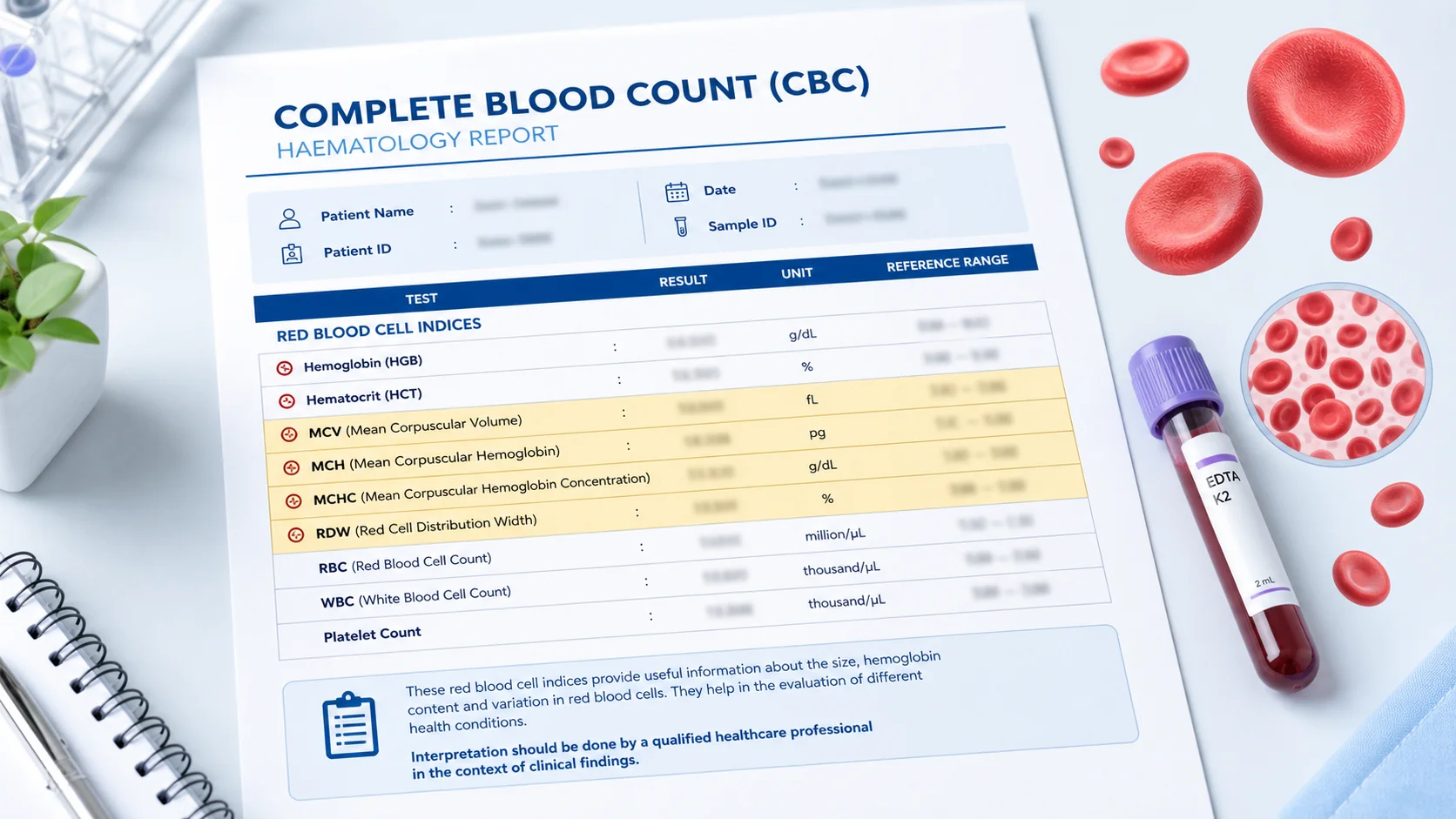
What is MCHC in a blood test?
MCHC is the average concentration of hemoglobin inside your red blood cells. It is reported as part of a CBC, along with hemoglobin, RBC count, hematocrit, MCV, MCH, RDW, WBC count, and platelets. MCHC helps doctors understand whether red blood cells appear less packed with hemoglobin than expected, but it does not diagnose a disease by itself.
MCHC full form is mean corpuscular hemoglobin concentration. In simple Hindi: red blood cell ke andar hemoglobin kitna concentrated hai. Hemoglobin is the oxygen-carrying protein in red blood cells.
Reliable medical references such as MedlinePlus and Mayo Clinic explain that a complete blood count is used to measure blood cells and related values, including red blood cell indices such as MCV and MCHC. Source: MedlinePlus CBC and Mayo Clinic CBC.
What is the normal range of MCHC?
Most labs report MCHC around 32-36 g/dL, but the exact reference range can vary slightly by laboratory, analyzer, age, pregnancy status, and reporting method. Always compare your value with the reference range printed on the same report.
| CBC value | What it tells you | Common report unit | How to read it safely |
|---|---|---|---|
| Hemoglobin | Oxygen-carrying protein level | g/dL | More important than MCHC for anemia severity |
| MCHC | Hemoglobin concentration inside RBCs | g/dL | Read with MCV, MCH, RDW, and hemoglobin |
| MCV | Average red blood cell size | fL | Low, normal, or high MCV changes the interpretation |
| MCH | Hemoglobin amount per red blood cell | pg | Often moves with MCV and MCHC |
| RDW | Variation in red blood cell size | % | High RDW can suggest mixed cell sizes |
The quickest decision rule is this: first check hemoglobin, then MCV, then MCHC and RDW. MCHC is useful, but it is not the first number doctors use to judge severity. If MCV is the value marked high or low on your CBC, read the focused MCV blood test meaning in Hindi guide before assuming the cause.
If your report flags MCH instead, use the separate MCH blood test meaning in Hindi guide; MCH measures hemoglobin amount per cell, while MCHC measures concentration.
What does low MCHC mean?
Low MCHC means red blood cells may have less hemoglobin concentration than expected. In many CBC reports, this pattern can appear with low hemoglobin, low MCV, low MCH, or high RDW. That pattern may push a doctor to check for anemia causes, but the report alone should not be used for self-diagnosis.
People often search "low MCHC blood test" after seeing values like 30 or 31 g/dL. Mildly low MCHC can happen with nutritional deficiency patterns, chronic blood loss patterns, recent illness, or lab variation, but only your doctor can connect it to your symptoms and history.
Ask for medical review sooner if low MCHC is combined with:
- hemoglobin below the lab's normal range
- breathlessness, fainting, chest discomfort, palpitations, or severe tiredness
- heavy periods, pregnancy, recent delivery, or known bleeding
- black stool, blood in stool, vomiting blood, or unexplained weight loss
- chronic kidney disease, cancer treatment, or long-term infection
If you are also trying to understand the overall CBC, read our plain-language guide to blood test reports. If the main issue is low Hb with tiredness, breathlessness, dizziness, or palpitations, read hemoglobin kam hone ke lakshan. If platelets are the concerning value, use this guide on platelet danger signs.
For a newer Hindi overview of the whole report, read CBC test meaning in Hindi, which explains hemoglobin, WBC, differential count, platelets, and RBC indices together.
What does high MCHC mean?
High MCHC means the reported hemoglobin concentration in red blood cells is above the lab's reference range. A high value should be interpreted carefully because it can sometimes be affected by sample handling, analyzer flags, or red blood cell changes that need confirmation.
Do not assume a high MCHC means one specific disease. Doctors may compare it with hemoglobin, bilirubin, reticulocyte count, peripheral smear, and whether the lab report has any flags. If the value is unexpectedly high but you feel well, the practical next step may simply be repeat CBC or review by a physician.
Urgent review is sensible if high MCHC appears with jaundice, dark urine, severe weakness, breathlessness, fever, severe abdominal pain, confusion, or rapidly worsening symptoms.
How do MCHC, MCV, MCH, and RDW work together?
Doctors read red blood cell indices as a pattern. MCHC tells concentration, MCV tells size, MCH tells amount of hemoglobin per cell, and RDW tells whether red blood cell sizes vary widely. A single abnormal value is less useful than the combination.
Here is a simple comparison:
| Pattern in report | What it may suggest to discuss | What not to do |
|---|---|---|
| Low hemoglobin + low MCV + low MCHC | A microcytic anemia pattern may need evaluation | Do not start iron randomly without advice |
| Low hemoglobin + high MCV | Vitamin B12, folate, liver, thyroid, medicine, or other causes may be reviewed | Do not assume iron is the answer |
| Normal hemoglobin + mildly low MCHC | Often needs context and sometimes follow-up, not panic | Do not treat one number alone |
| High RDW + abnormal MCV/MCHC | Mixed red cell sizes; doctor may correlate with deficiency or recovery patterns | Do not compare with internet ranges only |
The National Heart, Lung, and Blood Institute notes that doctors diagnose anemia using medical history, exam, and blood tests such as CBC, not one isolated number. Source: NHLBI anemia diagnosis.
When should you show a CBC report to a doctor?
Show your CBC report to a doctor if any important value is outside range, symptoms are present, or the same abnormality repeats. For many patients, the fastest useful visit is not about "treatment" immediately; it is about deciding whether the CBC needs repeat testing, iron studies, B12, folate, thyroid, kidney, liver, stool, or pregnancy-related evaluation.
Seek urgent care now if the report is abnormal and you have:
- chest pain, severe breathlessness, fainting, or confusion
- heavy bleeding, black stool, blood in stool, or vomiting blood
- high fever with severe weakness
- pregnancy with dizziness, bleeding, or severe fatigue
- hemoglobin marked very low by the lab or advised urgent review
For emergencies, call local emergency services or go to the nearest emergency department. R.K. Hospital's emergency department in Indrapuri, Bhopal can assess severe symptoms and decide whether observation, repeat CBC, or specialist review is needed.
What should you do before visiting the doctor?
Bring the full CBC report, not just a screenshot of the MCHC line. Also bring older reports if available, current medicines, supplement names, details of periods or bleeding, fever history, diet history, and any known chronic illness.
Checklist before consultation:
- note your hemoglobin, MCHC, MCV, MCH, RDW, WBC, and platelet values
- check whether the lab has marked any analyzer flags
- write down symptoms and when they started
- do not start or stop iron, B12, blood thinners, antibiotics, or painkillers without advice
- ask whether repeat CBC, peripheral smear, ferritin/iron studies, B12, folate, or stool testing is needed
If you are in Bhopal and need testing, see pathology lab services or blood test near Bima Hospital. For symptoms that feel urgent, use emergency care instead of waiting for a routine appointment.
FAQ
MCHC blood test ka matlab kya hota hai?
MCHC ka full form mean corpuscular hemoglobin concentration hai. Yeh CBC report mein red blood cells ke andar hemoglobin ki average concentration batata hai. Is number ko hemoglobin, MCV, MCH, RDW, symptoms, and doctor examination ke saath interpret karna chahiye.
Low MCHC dangerous hota hai kya?
Low MCHC akela emergency ka proof nahi hota. It can point toward anemia patterns, but the seriousness depends on hemoglobin level, weakness, breathlessness, bleeding, pregnancy, chronic illness, and other CBC values. A doctor should review the full report.
High MCHC ka kya reason ho sakta hai?
High MCHC sometimes happens because of sample or lab factors, and sometimes with certain red blood cell conditions. Do not self-diagnose from high MCHC alone. Ask your doctor whether the CBC should be repeated or compared with smear, bilirubin, or other tests.
MCHC, MCV, MCH, and RDW mein kya difference hai?
MCHC shows hemoglobin concentration inside red blood cells. MCV shows red blood cell size. MCH shows hemoglobin amount per red blood cell. RDW shows variation in red blood cell size. Doctors read them together, not separately.
Bottom line
MCHC is useful because it adds detail to a CBC report, but it is not a diagnosis. Read it with hemoglobin, MCV, MCH, RDW, symptoms, and trend. If the report is abnormal or you feel unwell, get a doctor to review the full CBC rather than treating the number yourself.
R.K. Hospital, Indrapuri, Bhopal offers CBC testing, pathology support, emergency review, and physician consultation. For appointments or report review, call 0755-4260605 or visit the contact page.
Read the report or prescription in context
A laboratory result or scan is one part of an assessment. Reference ranges vary by method and laboratory, and an out-of-range number does not by itself identify a disease. A clinician interprets the complete report alongside symptoms and previous results.
Lab tests, scans and understanding a report: preparation, interpretation and questions to askRelated Pages on R.K. Hospital
Read Next
- MCH Blood Test Meaning in Hindi: Low, High, Normal RangeDiagnostics · 8 min read
- MCV Blood Test Meaning in Hindi: Low, High, Normal RangeDiagnostics · 10 min read
- RDW Blood Test Meaning in Hindi: High RDW, Low RDWDiagnostics · 10 min read
- Bilirubin Test Meaning in Hindi: Total, Direct, Indirect SamjheinDiagnostics · 8 min read
- CBC Test Meaning in Hindi: Hb, WBC, Platelet Ka MatlabDiagnostics · 12 min read
Need a Doctor in Bhopal? Talk to R.K. Hospital
This article is for general information only and does not replace a consultation. Call, WhatsApp, or walk in 24x7 at R.K. Hospital, Indrapuri, near Bima Hospital.
226, C-Sector, Indrapuri, Raisen Road, Bhopal (M.P.) 462022 · Directions & timings · 24x7 Emergency