How to Organize Medical Records for a Doctor Appointment
Organize medical records for a doctor appointment with a simple one-page summary, chronological file system, and checklist for reports, medicines, and questions.
Ten minutes spent sorting medical records can save much of a short appointment from being used to search through phone galleries, duplicate reports, and old prescriptions. The goal is not to carry every medical paper you have ever received. It is to give the doctor the right history, in the right order, with the current problem easy to find.
Fast rule: make a one-page health summary, divide records into five categories, arrange each category newest first, and put today’s reason for visiting on top.
This guide is general patient education, not diagnosis or prescription advice. Do not start, stop, or change medicines because of a report or this article. Ask the treating clinician what documents are relevant to your situation. Do not delay emergency care to collect records. Severe chest pain, major breathing difficulty, fainting, confusion, seizure, new facial or limb weakness, trouble speaking, uncontrolled bleeding, or rapid worsening needs urgent medical assessment. R.K. Hospital, Indrapuri, Bhopal has 24/7 emergency support; call 0755-4260605.
What does it mean to organize medical records?
Organizing medical records means grouping important health information by purpose and date so a clinician can quickly understand the current concern, health background, medicines, allergies, investigations, and previous care. A useful file supports clinical review; it does not replace a consultation or prove a diagnosis.
MedlinePlus describes a personal health record as health information that a patient maintains and notes that it can include conditions, medicines, allergies, tests, procedures, and family history. Your folder can be paper, digital, or both. Consistent labels matter more than an elaborate system.
What is the easiest way to organize records before an appointment?
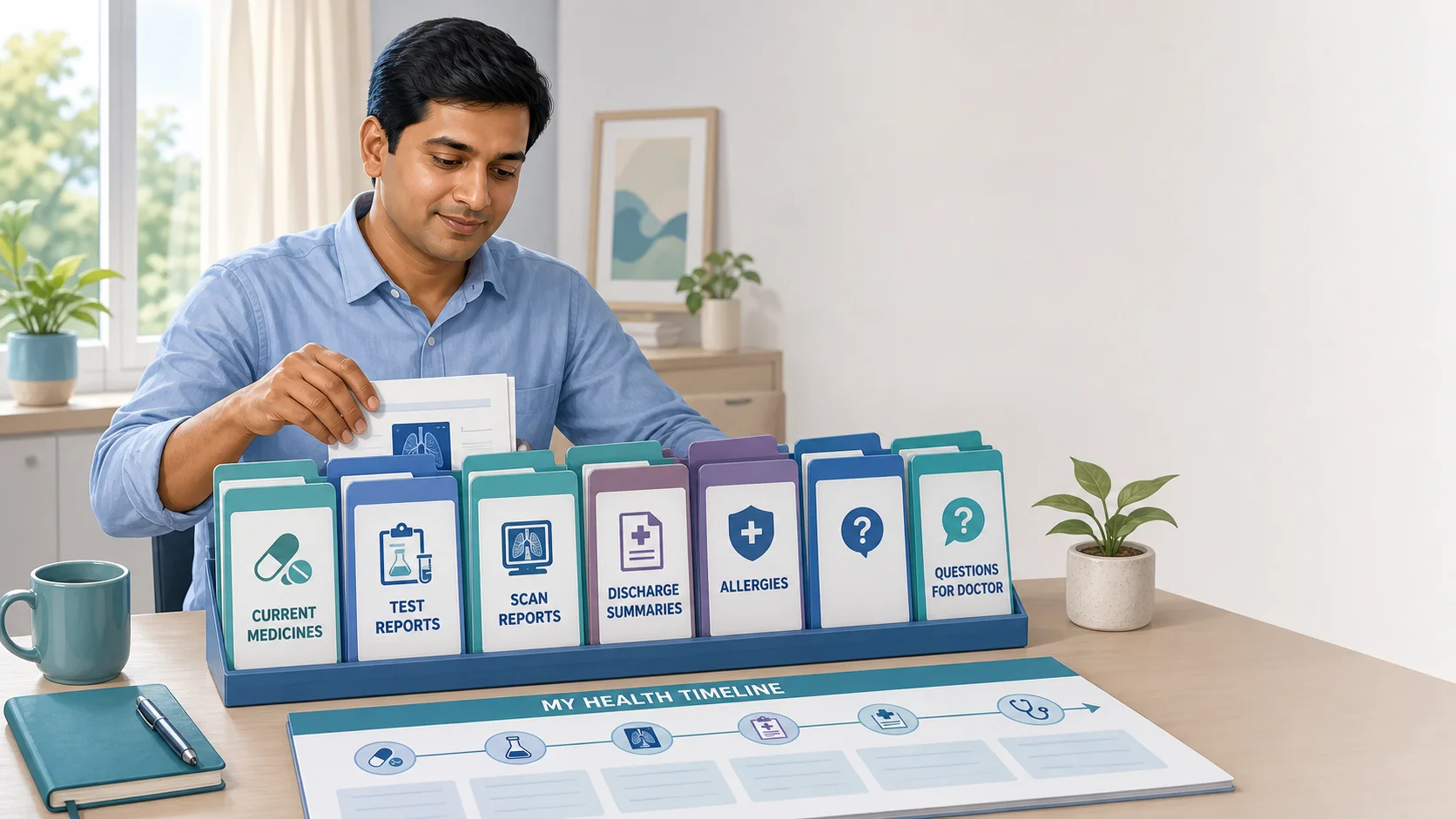
Use five sections: summary, medicines, consultations, tests and scans, and hospital or procedure records. Put the one-page summary first and arrange documents newest first inside every section. This structure lets the doctor find current information quickly while keeping older context available when needed.
| Section | Put this inside | Best order |
|---|---|---|
| One-page summary | current concern, major conditions, allergies, operations, emergency contact | single current page |
| Medicines | current prescription, non-prescription products, supplements, medicine photos | current list first |
| Consultations | recent prescriptions, referral notes, specialist opinions | newest first |
| Tests and scans | laboratory reports, ECG, X-ray, ultrasound, CT/MRI reports and requested images | group by test, newest first |
| Hospital and procedures | discharge summaries, operation notes, implant details, vaccination records | newest first |
Use separators or five digital folders with the same names. Remove duplicates, but do not discard original medical records without checking whether they may be needed later.
What should go on a one-page health summary?
A one-page health summary should identify the patient, explain today’s main concern in one or two lines, and list information that can affect safe decisions. Keep it factual and mark uncertain dates or details as uncertain instead of guessing.
Include:
- full name, date of birth, phone number, and emergency contact
- reason for today’s appointment and when the concern began
- major current or past health conditions
- previous operations, admissions, and important procedures with approximate dates
- medicine or food allergies and what reaction occurred, if known
- current medicines and supplements
- relevant pregnancy information, when applicable
- names of clinicians or hospitals involved in ongoing care
- preferred language or communication support needed
The National Institute on Aging recommends preparing a list of concerns and bringing medicine information before a doctor visit. If the history is complicated, start with the medical history checklist for an OPD visit.
How should you prepare a current medicine and allergy list?
Write the exact medicine name, strength, form, how it is currently taken, and why it was prescribed when known. Include non-prescription medicines, vitamins, herbal products, inhalers, creams, and injections. Add allergies separately and describe the reaction rather than writing only “allergy.”
Do not copy an old prescription and assume it is current. Compare the list with the packets or bottles you actually use. If a name is unclear, carry the strip, bottle, or a clear photograph. Do not combine duplicate brand and generic names yourself; let the doctor or pharmacist review them.
For a ready-to-copy format, use this medicine list for a doctor visit. Never stop a medicine merely because it seems absent from an old record; contact the prescribing clinician for advice.
Which test reports and scans should you bring?
Bring records related to the reason for the appointment plus earlier results that show a meaningful comparison. A complete report is more useful than a cropped abnormal value. Keep the patient name, test date, laboratory, units, reference ranges, and all pages visible.
Prioritize:
- the newest relevant laboratory report and one or more useful earlier reports
- the written report for relevant X-rays, ultrasounds, CT scans, or MRI scans
- scan images, films, or discs if the clinic asks for them
- pathology or biopsy reports when relevant
- referral letters and the note explaining why a test was ordered
- discharge summaries and procedure records linked to the current concern
Do not order or repeat tests independently just to complete a folder. The clinician should decide which investigations are useful and when. For laboratory-review preparation, see questions to ask about blood test results.
How should digital medical records be named and stored?
Save each file with the date, record type, and facility—for example, 2026-08-12-CBC-LabName.pdf—and keep all appointment files in one offline-accessible folder. Clear names and PDF documents are easier to search than screenshots scattered across messaging apps.
Use these practical safeguards:
- Download files before leaving home; do not depend on mobile data at the clinic.
- Check that every page opens and belongs to the correct patient.
- Use a phone or device lock and avoid sharing an unrestricted public link.
- Send records only through a channel the hospital or clinician confirms.
- Keep an encrypted backup or another secure copy of important records.
- Carry paper copies of the one-page summary, medicine list, and essential reports when possible.
Protect privacy when using shared devices or print shops. Medical files can contain addresses, phone numbers, identifiers, and sensitive history.
What can you leave out of the appointment folder?
Leave out duplicates, unrelated routine paperwork, illegible photographs, and pages that add no useful history—but keep originals safely elsewhere. A focused appointment folder is easier to review than an unsorted bag. When unsure whether an older report matters, keep it in a separate archive and mention it.
Do not hide a record because it feels embarrassing or appears inconsistent. Tell the clinician about uncertain dates, medicines taken differently from the label, care received elsewhere, and alternative or herbal products. Accurate information supports safer decisions.
What should you check the night before the appointment?
Confirm the appointment, required preparation, documents, transport, and your top three questions. Some tests or procedures have specific fasting, hydration, medicine, clothing, or companion instructions, but these are not universal. Follow only instructions provided for your appointment.
For a preventive visit that may include laboratory or imaging tests, pair this filing system with the annual health checkup preparation checklist so you confirm the purpose of the visit, test-specific instructions, and who will review the results.
Final checklist:
- one-page health summary is updated
- medicine and allergy list matches current use
- relevant records are sorted newest first
- every digital file opens without internet access
- identification, referral, and payment or insurance documents are packed if required
- top three questions are written down
- clinic has confirmed any special preparation
- a family member or interpreter is arranged if helpful
The OPD documents checklist covers administrative paperwork. If you are unsure which specialist or service to book, contact the hospital before travelling rather than choosing from a report alone.
What if records are missing or you cannot remember details?
Bring what you have and clearly identify gaps. Write the names of previous hospitals, approximate dates, procedures, known allergies, and medicines you remember. Ask the relevant provider about its process for obtaining copies. A clinician can decide whether missing information must be retrieved before a routine decision.
Do not postpone urgent assessment while trying to build a perfect file. In an emergency, take essential medicine and allergy information if immediately available, but prioritize getting help. Family members can bring other records later.
Where can you arrange a doctor appointment in Bhopal?
R.K. Hospital, Indrapuri, Bhopal provides outpatient consultations, multiple specialist services, pathology support, and 24/7 emergency assessment. When booking, state the reason for the visit and ask which reports, scan images, referrals, or preparation instructions apply.
Review doctors at R.K. Hospital, explore hospital services, or use the contact page for appointment and location information. Call 0755-4260605. Severe or rapidly worsening symptoms need urgent assessment rather than a routine appointment.
Frequently Asked Questions
What medical records should I bring to a doctor appointment?
Bring a one-page health summary, current medicine and allergy list, relevant test and scan reports, recent prescriptions or consultation notes, discharge summaries, surgery records, and previous reports that show a useful trend. Ask the clinic if original images or other documents are required.
Should medical records be arranged newest first?
Usually, yes. Keep the newest relevant record first within each category so the doctor can see the current situation quickly. Retain older reports when they show a trend, major diagnosis, operation, hospital admission, allergy, or important treatment decision.
Can I show medical reports on my phone?
Digital copies can help, but do not rely on scattered chat images or an internet connection. Save clearly named files in one folder and carry essential paper copies when possible. Ask in advance whether the clinic needs printed reports, scan films, discs, or original documents.
What should I do if I cannot find all my old medical records?
Do not delay urgent care while searching for paperwork. For a routine visit, bring what you have, write down remembered hospitals, procedures, allergies, and medicines, and ask previous providers how to request missing records. Tell the doctor when information is uncertain.
Part of the general-physician visits, tiredness and preventive health guide
Choosing a doctor for this concern in Bhopal
When choosing a doctor for general-physician visits, tiredness and preventive health, check the qualifications and whether the clinician’s usual work matches the concern. A general-physician consultation, a specialist assessment and a surgical consultation serve different needs. Tell reception the main symptom so the first booking is useful.
Ask whether the doctor will review your existing reports, explain the diagnosis and alternatives, and give a follow-up plan. Consider privacy, examination arrangements, communication and access to any specialist or procedure that may be needed. Bring a written list of questions if it helps you assess the recommendation.
For patients searching across Bhopal, confirm the actual clinic address and individual availability before travelling. At R.K. Hospital the location is 226, C-Sector, Indrapuri, Raisen Road. A nearby locality page describes access to this location; it does not mean a separate branch or a guaranteed journey time.
- 1
Describe the pattern and impact
- 2
Review history, examination and medicines
- 3
Select relevant tests or referral
- 4
Agree treatment and a follow-up plan
The sequence explains planned care. Urgent symptoms require prompt assessment and may change this pathway.
The assessment before a treatment decision
A clinician reviews the history and examination before choosing investigations. A blood count or other test may be appropriate for particular symptoms, but there is no universal set of tests that explains every case of weakness.
Medical guidance: NHS: Iron-deficiency anaemia · MedlinePlus: Choosing a doctor
What should I check when choosing a doctor in Bhopal?
Check verified qualifications, experience relevant to the concern, a clear explanation of diagnosis and treatment choices, follow-up arrangements, location and availability. Ask reception to route pregnancy, infertility, procedural or complex specialist concerns to the appropriate clinician.
Continue with symptoms, treatment options, warning signs and related guides
Related Pages on R.K. Hospital
Read Next
- Doctor Appointment Anxiety: A Calm Checklist Before Your VisitGeneral Health · 10 min read
- Follow-Up Doctor Appointment Checklist: What to Bring and AskPatient Guide · 9 min read
- Medical History for Doctor Visit: What Patients Should Tell Before OPDGeneral Health · 11 min read
- Missed a Doctor Appointment? What to Do NextPatient Guide · 8 min read
- New Diagnosis Doctor Appointment: Questions to Ask and What to BringPatient Guide · 9 min read
Need a Doctor in Bhopal? Talk to R.K. Hospital
This article is for general information only and does not replace a consultation. Call, WhatsApp, or walk in 24x7 at R.K. Hospital, Indrapuri, near Bima Hospital.
226, C-Sector, Indrapuri, Raisen Road, Bhopal (M.P.) 462022 · Directions & timings · 24x7 Emergency