How to Take Symptom Photos for a Doctor Appointment
Learn how to take clear, private symptom photos for a doctor: use wide, comparison, and close-up views, record timing, and know when not to wait.
A rash may fade before your appointment. Swelling can change during the day. A brief tremor or unusual movement may stop before you reach the clinic. A clear photo or short video can preserve useful context—but a blurred close-up with no date or body location may create more questions than answers.
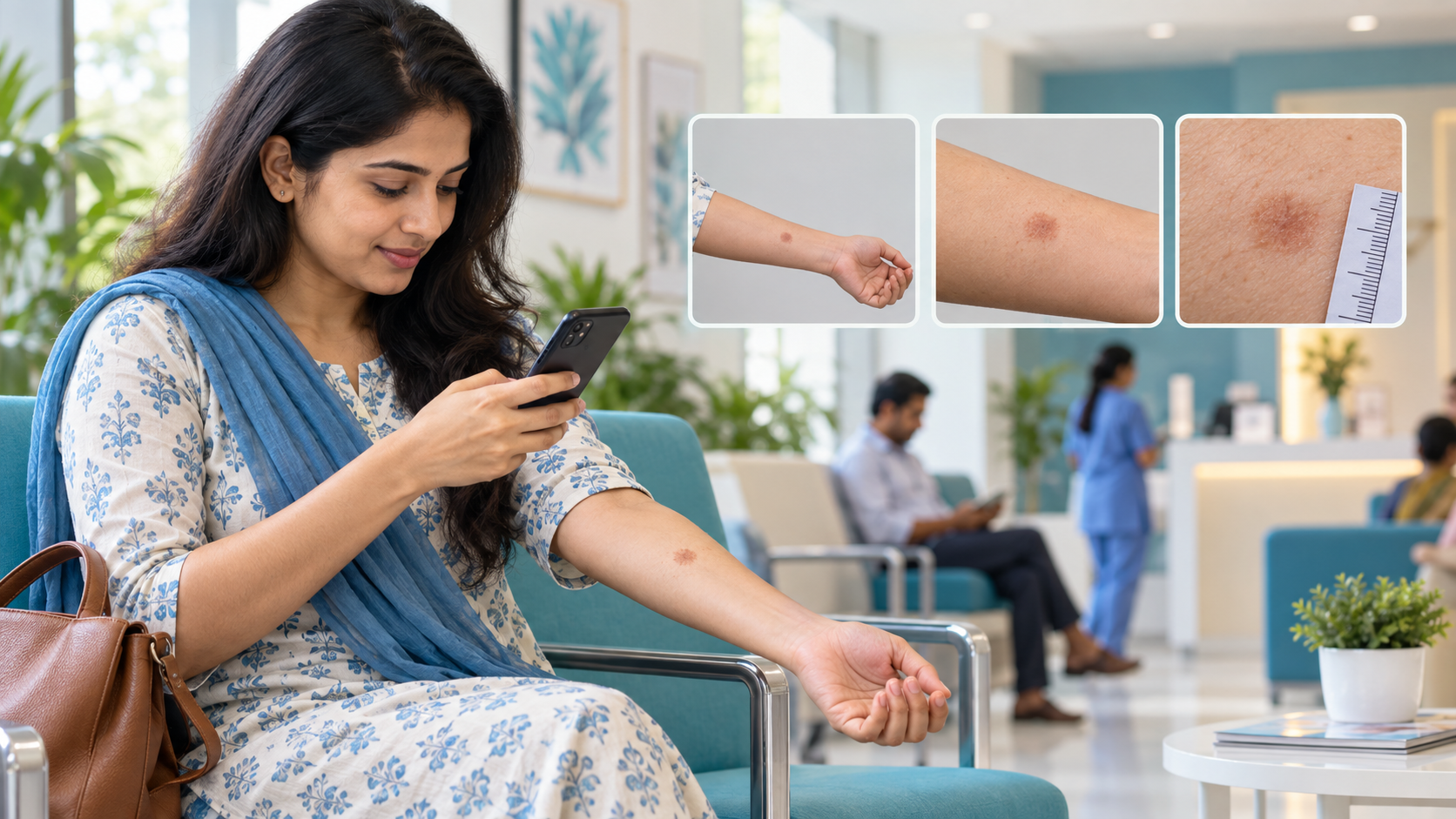
Fast rule: take three honest, unedited views—wide, comparison, and close-up—then add the time, body location, symptoms, and what changed. Photos support a medical history; they do not diagnose the cause or replace an examination.
This is patient education, not diagnosis or prescription advice. Do not delay urgent care to photograph a symptom, and do not start, stop, or change treatment based on an image or an online match. For urgent help at R.K. Hospital, Indrapuri, Bhopal, call 0755-4260605.
What is a symptom photo for a doctor?
A symptom photo is a dated, unedited image that records how a visible health change looked at a specific time. It can help a clinician understand appearance, location, size, or change over time when the symptom is intermittent or looks different by the appointment. It is one piece of the history, not a diagnosis.
The American Academy of Dermatology (AAD) explains that clear skin or nail photos can help during telemedicine, show how a concern changes, and support follow-up. MedlinePlus also advises patients to prepare a symptom description that includes when it began and what makes it better or worse.
Photos are most useful for visible changes such as a rash, swelling, bruise, wound appearance, eye redness, or a change that comes and goes. A short video may be useful for an intermittent movement, cough pattern, breathing sound, or walking difficulty—but recording must never delay emergency care or place the patient at risk.
How do you take a clear rash or symptom photo?
Use bright, even light; a plain background; the normal camera setting with filters off; and steady focus. Take one wide view for location, one comparison view with nearby unaffected skin, and one close-up for detail. Keep the image true to what you see rather than trying to make the change look stronger.
| View | What it should show | Why it helps |
|---|---|---|
| Wide or orientation | The body area and exact location | Prevents confusion about where the symptom is |
| Comparison | The affected area plus nearby unaffected skin, or both limbs when appropriate | Shows contrast and distribution |
| Close-up | Texture, edge, colour, and a clean ruler beside—not over—the area | Records detail and approximate size |
The AAD recommends these three perspectives and says natural light, a neutral one-colour background, sharp focus, and freedom from glare or shadow make images more useful. Check every photo before saving it. If it looks blurred or a shadow changes the colour, retake it.
Do not press, scratch, squeeze, or repeatedly irritate the area to make it visible. Remove a covering only if a healthcare professional has said it is safe to do so. For wounds, dressings, burns, recent operations, or devices, follow the care team's instructions rather than removing anything for a picture.
What should you record with each symptom photo?
Record the date and time, exact body location, when the symptom began, how it has changed, related symptoms, possible exposures, and anything already applied or taken. The photo captures appearance; the note supplies the timeline and context a camera cannot show.
Use this compact caption:
24 September, 8:15 am — left forearm. First noticed last night. Area appears wider this morning and feels itchy but not painful. No fever or breathing difficulty. Used no cream or new medicine. New laundry product used two days ago.
Include only what you know. “Red patch after a new product” is an observation; “allergic dermatitis” is a diagnosis you should not assign yourself. If you have several changing symptoms, pair the images with a symptom diary before the doctor visit.
Useful context can include:
- whether the area is itchy, painful, warm, numb, bleeding, or producing fluid
- whether it is spreading, fading, recurring, or changing colour
- fever, vomiting, breathing difficulty, dizziness, swelling, or other symptoms
- recent illness, injury, travel, insect exposure, new food, cosmetic, detergent, medicine, or supplement
- products or medicines already used and the time used
Do not repeatedly test a suspected trigger. Do not apply a new product only to see whether the photo changes.
How often should you take comparison photos?
Take comparison photos only often enough to show a meaningful change or at the interval a clinician recommends. Use the same angle, distance, lighting, body position, and scale each time so differences are less likely to come from the camera setup.
Create one album for the concern and keep the original files. Name or caption them with date and time. For a rapidly changing symptom, contact a clinician rather than building a large photo diary without advice. The AAD advises asking the dermatologist how often to photograph a skin concern because the appropriate interval differs by patient and condition.
A ruler can help with size, but do not let it touch an open, painful, or possibly infected area. Avoid coins or objects that may be dirty when the skin is broken. Never rely on a phone's beauty mode, colour filter, portrait blur, or automatic enhancement for a medical comparison.
When is a short symptom video more useful than a photo?
A short video may show movement, sound, duration, or sequence that a still photo cannot capture. Examples include an intermittent tremor, brief abnormal movement, cough, noisy breathing, gait change, or an episode that has stopped before the appointment. Record safely and describe what happened before and after.
Keep the frame steady, show enough of the body for orientation, and record the time and approximate duration. Do not stage or provoke an episode. Do not make a patient walk if they may fall, repeat a painful movement, withhold help, or place a phone near traffic, water, machinery, or another hazard.
If the person is unconscious, having a seizure, struggling to breathe, showing stroke signs, or rapidly worsening, help them and seek emergency care. A recording is never the priority.
How should you share medical photos privately?
Ask the hospital or clinician which approved channel they use before sending a medical image. Symptom photos can reveal the patient's face, body, home, location, or other private information. Crop unrelated details only if doing so does not remove clinically useful orientation; keep an original copy available.
The AAD recommends contacting the doctor's office to learn how it securely receives photos. Avoid posting the image publicly, placing it in an open group, or sending it to unknown “diagnosis” accounts. Do not include another person in the frame without their consent.
Before sharing, check:
- the correct patient and body area are identified
- the file is the intended photo, not another private image
- the date and symptom note are attached
- no unnecessary identity document, address, or unrelated person is visible
- you are using the channel the hospital asked you to use
For a video consultation, review the online doctor consultation checklist before the call and keep relevant reports and medicine names nearby.
What mistakes make symptom photos less useful?
The common failures are blur, harsh flash, filters, extreme close-ups with no body location, missing dates, inconsistent lighting, and no symptom history. Another serious mistake is using an image-search match as proof of a diagnosis or treatment plan.
Avoid:
- flash glare that hides texture or changes colour
- screenshots of edited or compressed social-media images
- placing a ruler over the affected area
- photographing only one tiny spot when the distribution matters
- deleting originals after cropping or annotating copies
- using old images without their correct date
- sharing intimate images without first asking how the clinic handles them
- delaying an appointment because a photo “doesn't look serious”
Two conditions can look similar in a phone image, and lighting can make skin colour unreliable. The clinician may still need the history, examination, vital signs, or tests.
When should you seek care instead of taking more photos?
Seek urgent medical care when a visible symptom comes with breathing or swallowing difficulty, lip or tongue swelling, fainting, confusion, severe illness, rapid spread, intense pain, blistering or peeling skin, or rapid deterioration. Do not wait for a routine appointment or a perfect image.
The AAD's rash warning guidance advises medical attention for a rash covering much of the body, rapid spread, pain, fever or illness, blisters or open sores, or involvement of the eyes, lips, mouth, or genital skin. Trouble breathing or swallowing, or swelling of the eyes or lips, may require emergency care.
Go to the nearest emergency department or call 112 in India where available for:
- major breathing difficulty, choking, blue lips, or swelling of the tongue or throat
- fainting, seizure, severe confusion, or unusual drowsiness
- sudden face drooping, one-sided weakness, or speech difficulty
- a rapidly spreading painful rash with fever or severe illness
- widespread blistering, peeling, raw skin, or involvement of eyes or mouth
- uncontrolled bleeding, major burns, serious injury, poisoning, or rapid worsening
Use the allergic reaction and anaphylaxis emergency guide when swelling or breathing symptoms accompany a rash. Sudden neurological signs need immediate action; see the FAST stroke symptoms guide.
Where can you show symptom photos to a doctor in Bhopal?
R.K. Hospital, Indrapuri, Bhopal provides outpatient consultation, General Medicine, General and Laparoscopic Surgery, Gynecology, Orthopaedics, Pathology, Radiology, and 24/7 emergency support. Bring the original images, their dates, a short symptom timeline, current medicines, allergies, and relevant reports.
Photos can help the conversation, but the appropriate next step depends on clinical assessment. Review hospital services, see the doctor directory, or use the contact page for appointment and location details. For emergency warning signs, seek emergency care rather than waiting for a routine visit.
Frequently Asked Questions
How do I take a useful photo of a rash for a doctor?
Use bright neutral light, turn off filters and flash if it creates glare, focus carefully, and take three views: one showing the body location, one showing nearby unaffected skin, and one close-up with a clean ruler beside the area for scale.
What information should I save with a symptom photo?
Record the date and time, body location, when the change first appeared, whether it is spreading or changing, related symptoms, possible triggers, and any product or medicine already used. Do not guess a diagnosis from the image.
Is a symptom photo enough for a diagnosis?
No. A photo may help show appearance and change over time, but it cannot provide a complete history, physical examination, vital signs, or tests. A clinician decides whether an in-person assessment or further evaluation is needed.
When should I seek urgent care instead of taking more photos?
Seek urgent care for breathing or swallowing difficulty, swelling of the lips or tongue, fainting, confusion, a rapidly spreading painful rash, fever with severe illness, blistering or peeling skin, purple spots with serious illness, or rapid worsening.
Related Pages on R.K. Hospital
Read Next
- Symptom Diary Before Doctor Visit: Kya Likhein Aur Kaise Batayein?General Health · 10 min read
- 25 Questions to Ask Your Doctor During an AppointmentGeneral Health · 12 min read
- New Diagnosis Doctor Appointment: Questions to Ask and What to BringPatient Guide · 9 min read
- Home Blood Pressure Log for a Doctor Visit: What to Record and BringGeneral Medicine · 10 min read
- How to Find a General Physician in Bhopal: A 7-Point ChecklistGeneral Health · 9 min read
- How to Explain Symptoms to a Doctor: 60-Second Guide for PatientsGeneral Health · 11 min read
Need a Doctor in Bhopal? Talk to R.K. Hospital
This article is for general information only and does not replace a consultation. Call, WhatsApp, or walk in 24x7 at R.K. Hospital, Indrapuri, near Bima Hospital.
226, C-Sector, Indrapuri, Raisen Road, Bhopal (M.P.) 462022 · Directions & timings · 24x7 Emergency